note / 2026年6月2日
When AI Amplified My Own Self
AI-powered capability amplification delivers short-term high efficiency, but it can also lead to dependency and even anxiety.
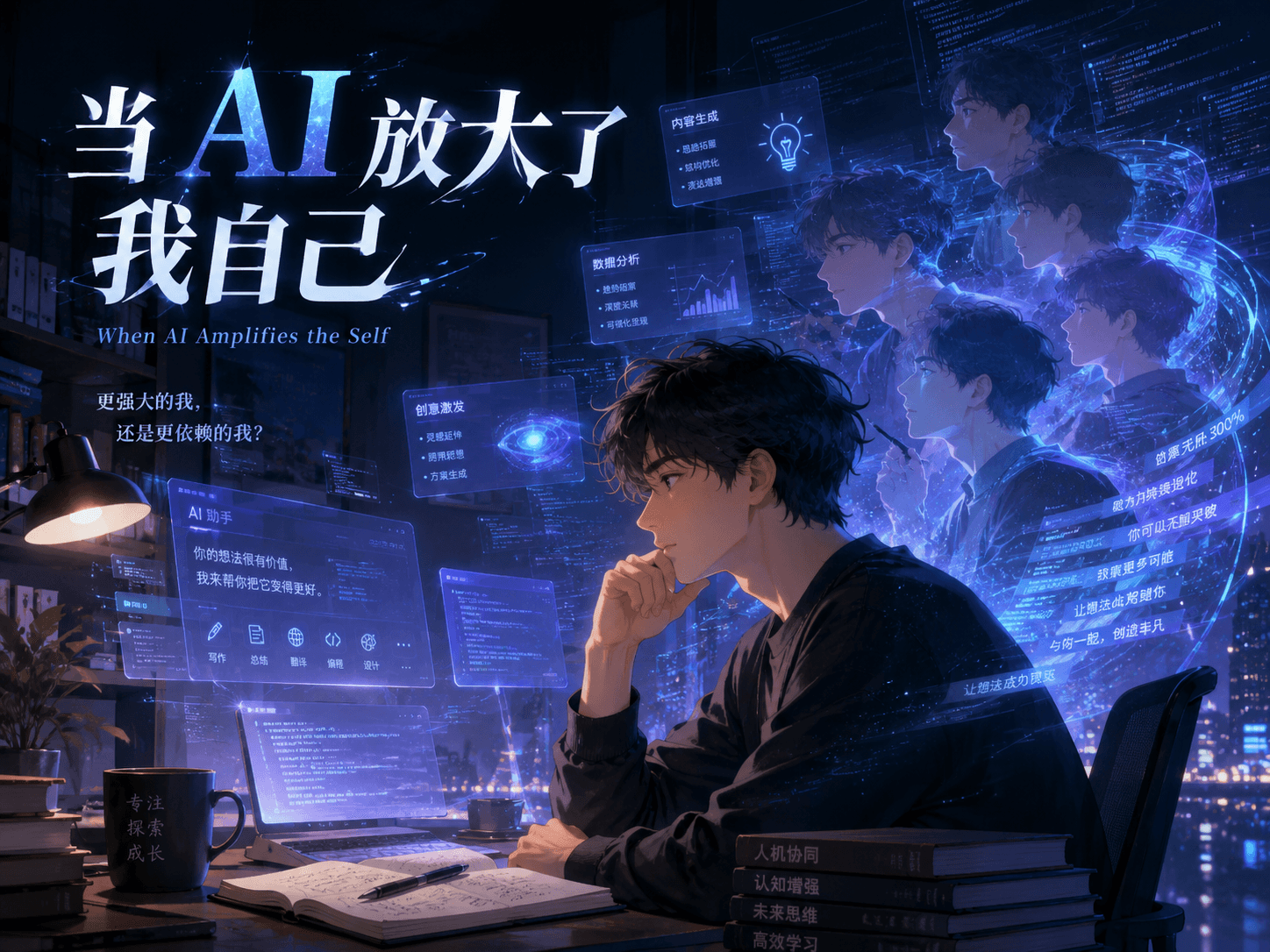
When AI Amplified My Own Self
Today, I used AI-assisted writing for the very first time, and finished an article that would have taken me two hours in just half an hour. Text streamed across the screen, every sentence more fluent and complete than what I would have produced thinking on my own. I felt excited, but also a strange twinge of dependency.
In the past, I always had to repeatedly brainstorm and refine every single sentence in my head; now, AI handles all those tedious steps for me. I was astonished by how productive I had become, but a quiet unease crept in: once I step away from the tool, I might struggle to write even a few coherent paragraphs.
I know this feeling is not just the thrill of faster speed. It is an amplification of my capabilities, the rush of briefly experiencing a "more ideal version of myself". Almost every attempt I make gets a satisfying result immediately — and before I knew it, I had started relying on it constantly.
Gradually, I noticed I started feeling anxious about creating anything without AI support. Even for a simple problem to work through, I would instinctively want to ask AI first: can I just get a clearer, ready-made answer? I realized I was not just addicted to convenience, but drawn to the illusion that I had become "far more capable".
This reminds me of my old study and work habits. We are used to aligning our efforts, achievements and self-evaluation with external benchmarks. AI seems to replicate this mechanism: it makes every attempt easy to succeed, and satisfies our sense of competence with almost zero friction. The problem is, when this enhanced state becomes the default, we may start to neglect our native capabilities, and even lose the patience to face the slow, unvarnished process of doing things ourselves.
Once, I tried writing a short essay completely without AI. Every pause, every revision felt like a small act of resistance. My thinking felt clunky, even a little anxious. But as time went on, I found the slowly refined text felt far more like "my own thoughts", rather than an instantly generated output.
I began to realize that what AI brings is not just convenience and high efficiency, but also psychological dependency. It gives people instant gratification and a sense of control, but it can also alter one's tolerance for the original, unassisted thinking process. This dependency is subtle — it does not produce immediate, severe side effects like a drug, but quietly reshapes the expectations you have for yourself.
What I want is a clear-headed self, not kidnapped by an artificially enhanced state, nor giving up on independent exploration.
To retain full agency over myself, I started setting boundaries: I reserve a portion of my creation time to work without AI, to experience the natural rhythm of independent thinking. Every time I slow down, I feel discomfort and anxiety, but it also lets me re-confirm exactly which part of my capabilities truly belongs to me.
In my daily work, I have also noticed that this low-friction capability boost makes tasks easier, but it also makes us prone to neglecting the patient, deliberate work required for complex problems. I remind myself often: short-term high efficiency does not equal long-term capability growth. Truly independent competence can only be forged through slowness, struggle, and deep thinking.
The process of writing this very article is also a reminder to myself: AI is a tool, not the ultimate judge. It can amplify capabilities, but it cannot replace self-awareness and personal value judgment. The moment I started questioning whether I was relying on it too much, I finally understood where the "sense of control" I crave really comes from — from myself, not from the tool.
Eventually, I realized that the allure of AI is not a bad thing. It showed me my own untapped potential, and also exposed my weak spot for dependency. The key question I have to ask myself is: when it is not there, will I still keep going? When that short-term efficiency boost disappears, will I still retain my judgment and passion for creation?
AI will likely always be here, ready to amplify my capabilities. But I hope the person who truly decides the rhythm and choices of my life will always be me.
I will not reject it, but I will never hand over my sense of self.