journal / 2026年6月2日
Waking Up Silently in the Depths of the Hustle and Bustle
When you realize that other people's needs cannot define your existence, you truly gain ownership of your own soul. This article explores self-independence, inner authenticity and soul autonomy, encouraging readers to examine their inner selves and achieve self-consistency.
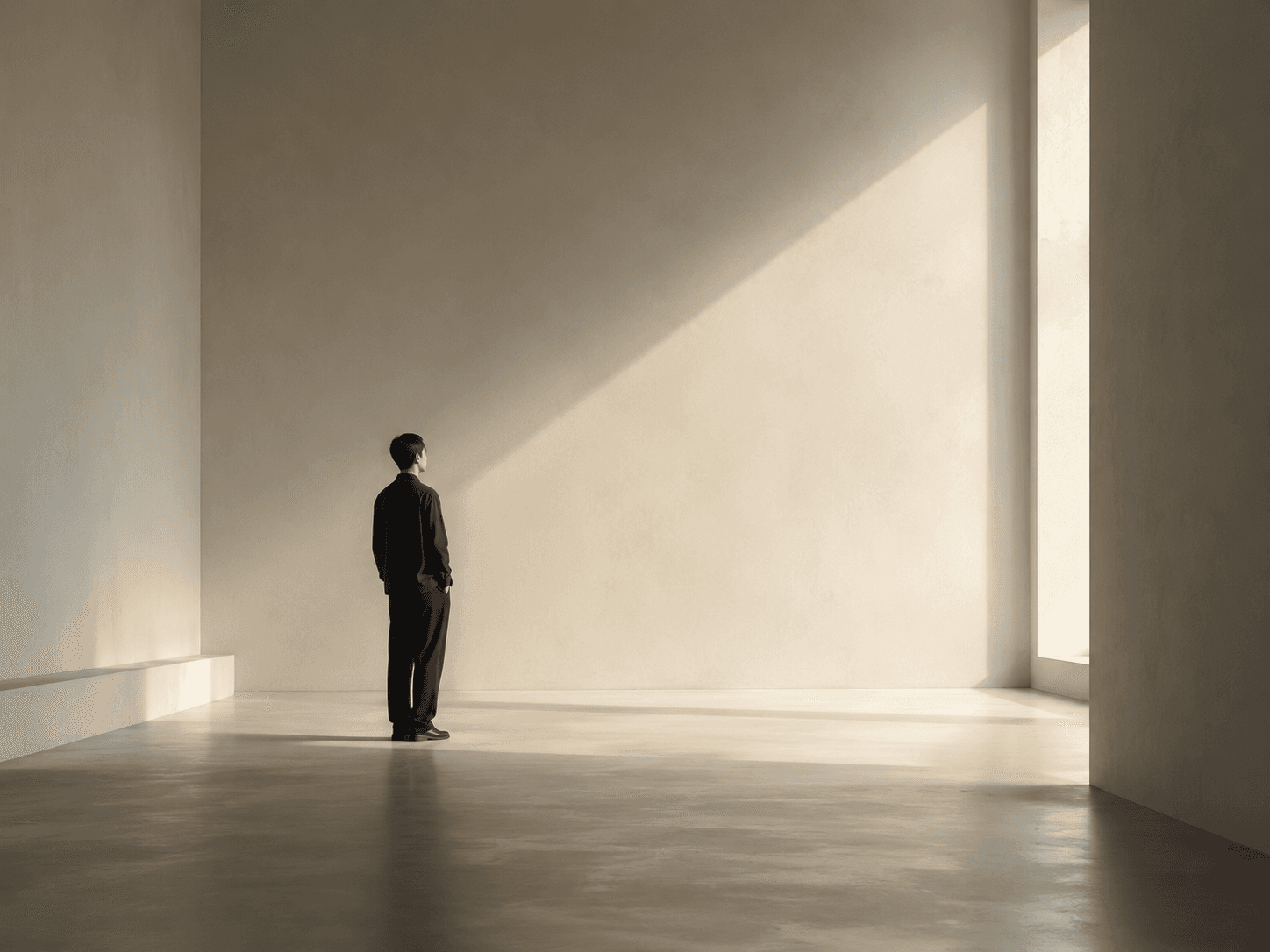
Wake Up Silently, Deep in the Hubbub
I was chatting with someone the other day, and a sharp, memorable line popped out — which made me want to expand on it, and talk through this whole topic about life.
There was a period where he felt like he was living far too hard.
Not the grand, dramatic kind of overexertion, but a tiny, frayed, perpetually tensed kind of effort.
He wakes up in the morning, his phone lights up, and the whole world has already started chattering. Someone posts a snapshot of their shiny new life, someone announces a new milestone, someone shares a newly trending "correct" take, someone drops a casual line in the comment section that feels like it's pressing some invisible button.
And he lights up too, right along with it.
Sometimes it's envy, sometimes anxiety, sometimes a vague, unplaceable shame. The thing in question has nothing at all to do with him, but his body has already reacted before his mind can catch up.
His chest sinks a little, and his brain starts running calculations automatically:
Am I falling behind? Am I not good enough? Should I be out there doing something too?
This reaction is so second-nature, so familiar, that he once thought that was just who he was.
Later he realized that wasn't him at all — it was just the echo the world had left inside his body.
It's so easy for people to mistake echoes for their own inner voice.
If other people say something is worth chasing, he starts to believe it's worth chasing too. If other people say a certain life is respectable, he slots that idea of respectability into his own life plan. If someone else frowns even slightly, he rushes to rewrite himself to fit.
Over time, his inner world becomes a house with no doors. Anyone can walk in, sit for a while, leave a few words, shift a few pieces of furniture around, then walk right out again.
The person who actually lives there ends up with less and less space to exist.
He used to take all these voices extremely seriously, almost devoutly so.
Back in school, test scores felt like divine prophecy. After he started working, his income felt like a final verdict. Later on, houses, cars, job titles, projects, social circles, online following — all of them turned into some kind of proof you were doing it right.
Each of these things on its own is practical, even necessary. But when they all pile together, they slowly coalesce into one giant, faceless presence.
That face never speaks, it just stares at you.
And so you start explaining yourself, start proving your worth, start handing in your assignments.
So many people live their whole lives this way, turning their existence into an endless stream of assignments to be turned in.
To their parents, to society, to their peers, to the blurry audience on their social media feeds, to a panel of judges that doesn't even exist, yet is everywhere.
You think you're living your life, but most of the time you're just waiting to get graded.
If someone gives you a little approval, you breathe a sigh of relief. If someone treats you with even faint dismissiveness, you start to wonder if your entire life was written wrong.
The most absurd part? That panel of judges almost never even knows who you are.
It's just a mess of passing glances, random offhand opinions, standards that grew out of other people's lives and got dumped onto yours.
But when you go too long without having your own internal yardstick, you start treating all these things as absolute truth.
They're like pop-up dialog boxes that show up everywhere you go in a game, every line glinting bright, looking like a quest, a hint, an order.
Later on, he learned not to click on them.
It's not apathy, and it's not arrogance. He just finally understood:
Not every voice deserves to make its way into your heart.
Most people are just passing through the edges of your life, saying a line that belongs entirely to them.
That line carries their own experiences, biases, fears, desires, their own unfulfilled lives.
You can hear it, but you don't have to worship it.
This is a tiny, quiet kind of awakening.
It doesn't start out grand, it even feels a little silly at first.
He laughs at himself inside his head:
Why did I let some irrelevant line carry me away again? Why did I treat someone else's life like my own progress bar? Why am I secretly adjusting my whole life to match the gaze of a total stranger?
As he laughs, he feels a little lighter.
The false grandeur of the world starts to crack.
All the things that once felt so heavy they could crush you start to show their seams, reveal they're just a constructed system.
It turns out so many of these things are not sacred at all — they've just been repeated for far too long. So many "successes" are not the final end goal, they're just a high score handed out by a certain system. So many desires don't come from inside you, they were fed to you over and over by the era, until they grew to look like they were yours.
He started to see that the world is just a game.
That doesn't mean you can treat real life carelessly.
Reality is never light. Bills are real, illness is real, parting from people you love is real, the cramped discomfort of poverty is real.
But the cruelty of reality is not the same thing as the supposed sacredness of the social ranking system.
Money matters, but money shouldn't get to explain your entire life for you. Status is useful, but status shouldn't become the shell your soul has to live inside. Other people's opinions affect your life, but they shouldn't be the final judge sitting in your heart.
So many people spend their whole lives grinding to level up, and never stop to ask why they even logged into this game in the first place.
They work hard to farm gear, hoard resources, unlock new skins, chase higher ranks.
Every stage looks reasonable, every anxiety feels fully justified.
But late at night, some kind of hollow feeling still rises up.
It's not because they don't have enough things. It's because they never actually got to decide what exactly they want to trade their whole life for.
The most powerful trick the material world pulls is not making people greedy — it's making them forget to ask questions.
It translates the messy complexity of a full human life into a handful of simple metrics:
- Annual income
- Total assets
- Educational background
- Job title
- Influence
- The quality of life visible in your photos
Once everything is translated into metrics, it's easy to compare, and easy to make people feel small.
You can instantly tell who's better, who's faster, who's more worthy of envy.
But all the parts of life that can't be translated into metrics slowly go quiet.
The clumsy, earnest joy someone feels while doing something they love goes quiet. The uncalculated softness in a relationship goes quiet. The indescribable peace you feel when you're alone goes quiet. The wholeness you keep after choosing to skip out on a loud, crowded gathering goes quiet.
These things are hard to show off, they don't really work for social media posts. They can't turn into instant applause, can't be directly converted into a price tag, can't prove you "won" against someone else. But more often than not, it's these unshowable things that decide whether you still belong to yourself.
He slowly realized that what he really needed to fight was not the world out there, but the part of the world that had snuck inside his heart and pretended to be "him".
That part would whisper:
You should be more successful than this. You're not living respectably enough. Everyone else is moving forward. If you don't prove your worth, people will look down on you.
It would even disguise itself as rationality, tell him this is just how the real world works.
But deep down, there was another voice, tiny, almost impossible to hear at first. It never rushes you, never hands you a pre-written answer. It just asks once in a while:
Is this actually what you want?
This question is more dangerous than any grand piece of life advice. Because once you take it seriously, you can't hide behind the "everyone does it" excuse anymore. You can't blame all your desires on the era, or all your emptiness on your surroundings.
You have to admit that some of these things you chose to take on yourself. Some of these standards you refused to let go of, even when they made you miserable. Some of these ranking systems stopped fitting you a long time ago, but you're still waiting to win an award inside them.
So awakening is never as bright and dramatic as it is in the movies. It's more like sitting alone in a dim room, finally noticing that you've been holding a rope this whole time.
The other end of that rope is tied to so many things:
- Other people's gazes
- The expectations you carried from childhood
- The shame of past failures
- The fear of poverty
- The resentment of falling behind
- The hunger to be loved
You used to think the world was yanking on the rope, but later you realize you never let go of it yourself.
Letting go doesn't happen all at once. Sometimes you loosen your grip a little, then grab on tight again. When you see someone else moving faster, you still panic. When you hear a dismissive comment, it still stings. When you run into someone living a flashier life, you still doubt your own choices. You can't break free of the whole world just by repeating a few pretty lines. Those trained, automatic reactions are like old neural pathways buried in your body — they take a very long time to wear down and stop firing.
But the second you see them for what they are, they already start to lose their power. He started to pull himself back, little by little, out of every pointless comparison. It's not that he stopped trying, or pretended he didn't care about anything. It's that he stopped pouring all his effort into the external grading system. He still works, still earns money, still cares about real-world wins and losses, but a quiet little space slowly opened up inside his heart. That space doesn't need to be shown off to anyone, doesn't need to prove anything to anyone.
In that space, he can ask himself very simple, unglamorous questions:
Am I doing this because I love it, or because I'm scared of losing? Am I chasing this thing because I need it, or because I want to be recognized? Do I care so much about what other people think because they're right, or because I don't trust myself in the first place? Am I actually living my life, or am I just performing a version of life that looks good to other people?
Eventually the questions get even simpler, and even harder:
Who am I? What am I willing to give my time to? If there was no applause, no comparisons, no one watching at all, would I still keep doing this thing?
The second you can ask yourself these questions, you're no longer fully trapped in the old world. Not that your body has left it, but the center of gravity of your perception has shifted. Before, he looked at himself through the coordinates the world handed him. Now, he's starting to look at the whole world through his own lived experience.
This step is completely silent, but it runs very deep.
The world is still the same world. Cities are still crowded, information still floods in nonstop, consumer goods are still tempting, people still size each other up as they pass.
But he no longer treats every bit of external feedback as a final verdict. Those voices still come, but not all of them can pierce through him anymore. Those rewards still glint bright, but not every single one is worth running after. Those strangers still talk, but not all of them get to rewrite the main plot of his life.
He's finally starting to live by his own set of standards.
This doesn't mean he puts himself above the whole world. It means he's finally putting himself back where he belongs, inside his own skin. So many people go their whole lives without ever doing this. They own so many things, but they don't own themselves. They're recognized by so many people, but they never truly recognized themselves. They ran the whole route someone else designed for them, and never knew where they actually wanted to go.
And the real, essential truth only shows up once all the noise and bustle fades away. It's not a bigger house, not a fancier job title, not a life that makes everyone else jealous. It might just be some night where you don't punish yourself for someone else's success. Some morning where you do something that gives you no external reward, but makes your inner self feel steady. Some choice where you don't betray yourself just to pick the option that looks "correct".
These moments are tiny, too tiny to put on a resume, too tiny for algorithms to push out to other people. But it's in these tiny moments that you slowly, piece by piece, find your way back to yourself.
Later he understood that re-seeing the world doesn't mean you get some fancy, superior new philosophy. It means you take the world down off the altar you built for it in your heart. You can understand it, use it, participate in it, and also choose to reject it. It's no longer this giant, omnipresent force that judges you at every turn. It's just a complex field of existence, with rules, temptations, dangers, and plenty of space for you to build something of your own.
He stopped rushing to become the kind of person the world likes. He'd rather become the kind of person he can stand to spend a long, lifetime with.
That line sounds light, but it takes years and years to actually live up to. Because it means you have to sort out your real needs from the pull of materialism, sort out useful feedback from the noise of other people's opinions, sort out your own voice from the roar of the era. You have to admit the world is powerful, but you don't hand yourself over to it. Admit you need to be loved, but don't disappear just to get that love. Admit you have to face reality, but don't let reality shrink your whole life down to nothing.
What's left in the end might just be a slow, steady inner order.
You know what to chase, what to let go of. You know which voices are just passing through, which words are worth taking seriously. You know you're not standing at the center of the whole world, but you absolutely have to stand at the center of your own life. If you don't, you'll get scattered little by little by all the "correct", loud, respectable, tempting things out there, until you can't recognize yourself anymore.
And when someone finally manages to find themselves through all that noise, they might not look any different on the outside. They're still ordinary, still quiet, still walking through crowds, still busy making a living. But something inside them has shifted.
They don't get swept away by every random thing that comes along anymore. They don't rush to explain themselves to everyone they meet. They don't translate every single bit of external feedback into a judgment of their own self-worth.
They start to choose quietly. Reject quietly. Love certain things quietly. Walk their own main path quietly.
Not because they beat the world, but because they finally stopped losing themselves to it.